I love shopping at thrift stores, though maybe just slightly less with bedbugs threatening to take over.
The other day I found a clear plastic bag with some sewing notions. I saw the bobbins first, then the needles and decided it was worth $1.50.
Many of the items will be useful but I don't recognize some of them. Maybe some of you know....
Those flat bobbins just left of center toward the top... what kind of machine uses those? I thought I could put them on the thread holder of my 201 but the hole is too small.
That needle plate cover.... what kind of machine is that for and what does it do?
Those little cream-colored plastic things toward the bottom.... What are those for?
And I'd ask you about the presser feet but the photograph probably isn't good enough for you to tell what they're for, other than the one at left which I know is a zipper foot.
Anyone want some ballpoint needles? I think they're only good for knit fabric.
I thought it was interesting to see 4 different kinds of packages for Singer needles. The little plastic cases look very handy.
That cloth pouch toward the top is folded over and closed with a safety pin. It has about a dozen sewing machine needles in it. I hope they're Singer brand.
The needle threaders all look the same but they are 3 different sizes. Maybe I will try the Dritz magnetic seam guide.
Are you a thrift store shopper?
--Nancy.
.
Showing posts with label Singer sewing machines. Show all posts
Tuesday, April 1, 2014
Monday, October 21, 2013
My Least Favorite Sewing Chore . . .
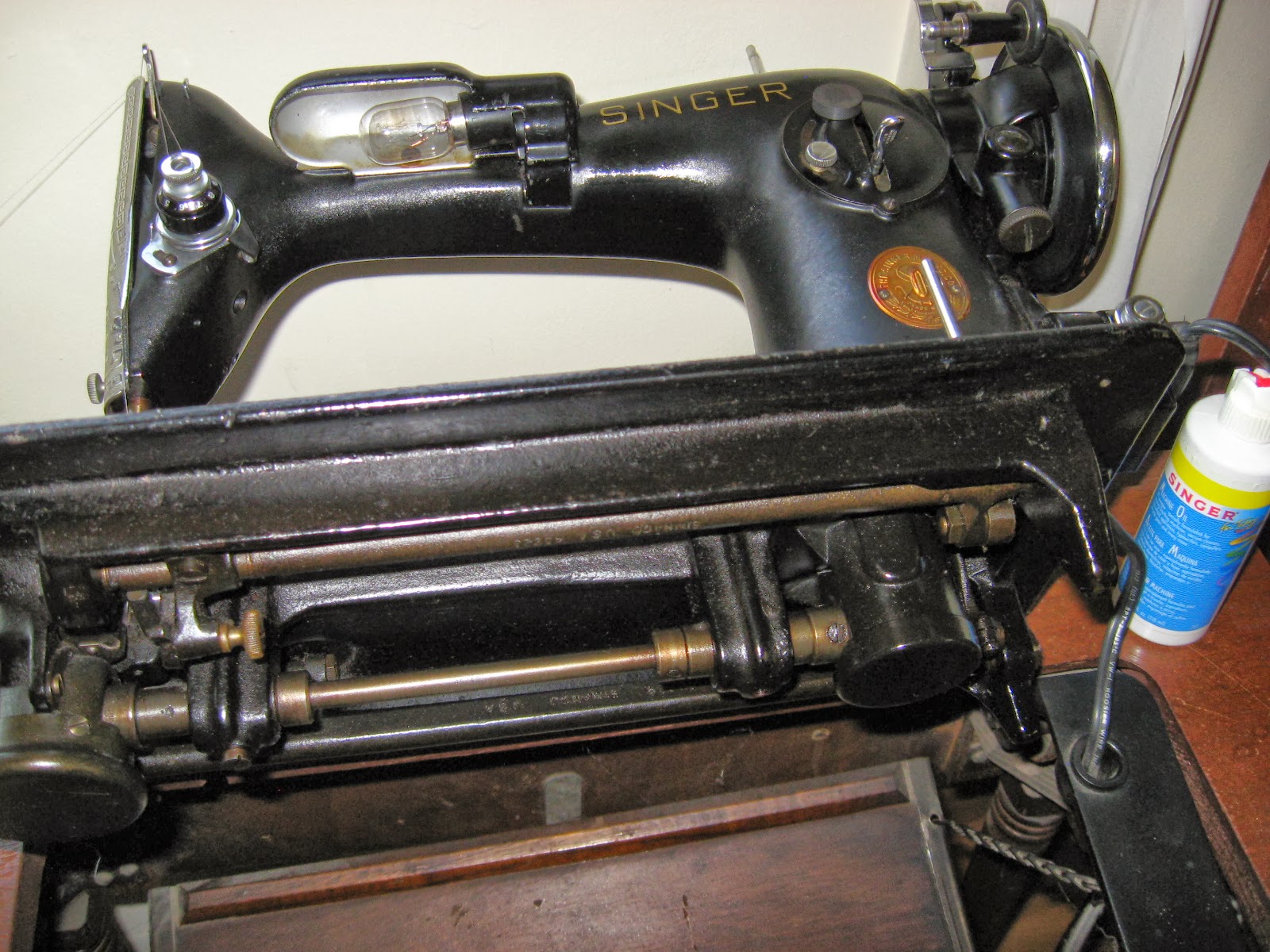
. . . is oiling my mother's old black Singer.
I don't like the smell of oil or the mess when the oil drips from the bottle (no matter how careful I am). I'm always afraid I'll miss some and get oil on whatever I'm sewing.
I have the original manual with oiling instructions. The illustrations are excellently rendered drawings but some of the little arrows that point to the spots to oil just don't seem too clear.
Still, it has to be done and I'm grateful to have the machine and that it's in good working order. So I oil.
And when I'm finished, my mother's old black Singer just purrs.
How about you? Do you enjoy oiling your machine? What's your least favorite sewing chore?
--Nancy.
.
I don't like the smell of oil or the mess when the oil drips from the bottle (no matter how careful I am). I'm always afraid I'll miss some and get oil on whatever I'm sewing.
I have the original manual with oiling instructions. The illustrations are excellently rendered drawings but some of the little arrows that point to the spots to oil just don't seem too clear.
Still, it has to be done and I'm grateful to have the machine and that it's in good working order. So I oil.
And when I'm finished, my mother's old black Singer just purrs.
How about you? Do you enjoy oiling your machine? What's your least favorite sewing chore?
--Nancy.
.
Tuesday, August 27, 2013
To Lift My Spirits
Our house was broken into on Saturday. My husband and I are both feeling somewhat unsettled. He is kind-hearted, generous, and has a healthy sense of humor. He never misses a "find" waiting to be rescued. Thinking to cheer me and lift my spirits, my husband brought me a gift this afternoon.
I can't exactly say that it works but all the parts move: the treadle treadles, the wheel and bobbin case turn, and the needle goes up and down. But I think it will take some loving care to get this machine back to sewing order, if that's even possible. (And I know nothing about repairing machines.)
It's too bad someone took the drawers, though I can understand wanting the drawers. They were probably lovely, even if dirty and dusty. I think the logo on the side is quite nice -- but , of course, it, too, needs some cleaning.
It doesn't make up for what was stolen but it was a fun surprise. It did help lift my spirits a little, though we're still feeling unsettled.
I hope you and the loved ones you cherish are safe.
--Nancy.
.
When he saw this in the alley near the library he couldn't resist. At first he thought it was just the cupboard and metal stand but when he lifted it, he realized there was more -- a machine folded down inside. I have no idea how he got it into our car by himself. It weighs a ton!
It's a Singer Class 27. (Sorry for the reflection.) It was made available in August, 1901, one of 38,499 others.
I can't exactly say that it works but all the parts move: the treadle treadles, the wheel and bobbin case turn, and the needle goes up and down. But I think it will take some loving care to get this machine back to sewing order, if that's even possible. (And I know nothing about repairing machines.)
It's too bad someone took the drawers, though I can understand wanting the drawers. They were probably lovely, even if dirty and dusty. I think the logo on the side is quite nice -- but , of course, it, too, needs some cleaning.
It doesn't make up for what was stolen but it was a fun surprise. It did help lift my spirits a little, though we're still feeling unsettled.
I hope you and the loved ones you cherish are safe.
--Nancy.
.
Thursday, March 21, 2013
Meet: My Mother's Old Black Singer . . .
. . . which is now my old black Singer.
I always assumed Mom received this sewing machine from my father as a wedding gift when they married in 1938, but I never asked and she never said. I recently discovered that Mom's Singer was made in 1941. Now I really wish I'd asked her how she came to have it!
I learned to sew on this machine when I was 8 or 9 years old. I don't remember my mom teaching me how to use it but I remember having free rein with it. I didn't learn to sew with patterns until I was in my teens but as a kid I remember sewing straight-seam items -- blankets, bags -- for my dolls. After I graduated from college, Mom and Dad delivered the sewing machine to my apartment. I was grateful to have it.
The machine sews forward and backward; has adjustable stitch lengths; and sews leather, cotton, and other fabrics. But it's not thrilled with polyester thread, for some reason. I usually sew with cotton, cotton/poly, or silk and it sew beautifully. It has a drop-in bobbin case and a knee pedal. Knee pedals are so much easier to use than foot pedals, at least for me. I can get much better control with a knee pedal. (I've always had a lead foot.)
The machine came to me with a box of attachments, a manual, and a buttonholer. I've never been able to get the attachments to work as the manual says they should but I keep them in their box and perhaps some day someone will show me how to use them. I use the manual whenever I have to oil the machine or fix the tension. It has sweet little detailed drawings telling where and how to oil.
The buttonholer came in this ovalish spaceship sort of plastic box. I never liked that box. I found a rectangular, dark green box with a buttonholer at the thrift store and bought it on the off chance it would work with Mom's macine. It did. And it had a 5/8" cam which Mom's didn't. I was getting ready to switch the buttonholer and get rid of the spaceship box when my daughters realized what I had in mind. They both balked: "But I love that box! That's the best thing about the sewing machine," they both said. (Neither of them sews much....) So I've kept the spaceship box.
My mother's old black Singer is almost the only machine I've ever used. I once borrowed a machine while in college. It had a foot pedal that I could never control and I think the only sewing I did was a quick repair. I have my mom's second sewing machine, the one she got after she gave me the old black Singer. It is a Kenmore which I don't like at all. I also have a slant-needle Featherweight Singer that I bought at an auction for $2.50. It sews as well as Mom's Singer but the bobbin is not so easy to put in. I've used it a few times but only when I've had to sew away from home or when the old black Singer needed a tune-up. And I recently bought the Singer Red Eye which does not yet sew.
My mother's old black Singer is the only sewing machine I've ever wanted. If it dies before I do, I don't know what I'll do....
I'm linking this post to Meet: My Machine! blog hop, hosted by Stacey at The Tilted Quilt and Erin at Sew at Home Mummy. Thanks, Stacey and Erin.
Happy sewing!
--Nancy.
.
I always assumed Mom received this sewing machine from my father as a wedding gift when they married in 1938, but I never asked and she never said. I recently discovered that Mom's Singer was made in 1941. Now I really wish I'd asked her how she came to have it!
I learned to sew on this machine when I was 8 or 9 years old. I don't remember my mom teaching me how to use it but I remember having free rein with it. I didn't learn to sew with patterns until I was in my teens but as a kid I remember sewing straight-seam items -- blankets, bags -- for my dolls. After I graduated from college, Mom and Dad delivered the sewing machine to my apartment. I was grateful to have it.
The machine sews forward and backward; has adjustable stitch lengths; and sews leather, cotton, and other fabrics. But it's not thrilled with polyester thread, for some reason. I usually sew with cotton, cotton/poly, or silk and it sew beautifully. It has a drop-in bobbin case and a knee pedal. Knee pedals are so much easier to use than foot pedals, at least for me. I can get much better control with a knee pedal. (I've always had a lead foot.)
The machine came to me with a box of attachments, a manual, and a buttonholer. I've never been able to get the attachments to work as the manual says they should but I keep them in their box and perhaps some day someone will show me how to use them. I use the manual whenever I have to oil the machine or fix the tension. It has sweet little detailed drawings telling where and how to oil.
The buttonholer came in this ovalish spaceship sort of plastic box. I never liked that box. I found a rectangular, dark green box with a buttonholer at the thrift store and bought it on the off chance it would work with Mom's macine. It did. And it had a 5/8" cam which Mom's didn't. I was getting ready to switch the buttonholer and get rid of the spaceship box when my daughters realized what I had in mind. They both balked: "But I love that box! That's the best thing about the sewing machine," they both said. (Neither of them sews much....) So I've kept the spaceship box.
My mother's old black Singer is almost the only machine I've ever used. I once borrowed a machine while in college. It had a foot pedal that I could never control and I think the only sewing I did was a quick repair. I have my mom's second sewing machine, the one she got after she gave me the old black Singer. It is a Kenmore which I don't like at all. I also have a slant-needle Featherweight Singer that I bought at an auction for $2.50. It sews as well as Mom's Singer but the bobbin is not so easy to put in. I've used it a few times but only when I've had to sew away from home or when the old black Singer needed a tune-up. And I recently bought the Singer Red Eye which does not yet sew.
My mother's old black Singer is the only sewing machine I've ever wanted. If it dies before I do, I don't know what I'll do....
I'm linking this post to Meet: My Machine! blog hop, hosted by Stacey at The Tilted Quilt and Erin at Sew at Home Mummy. Thanks, Stacey and Erin.
Happy sewing!
--Nancy.
.
Thursday, January 10, 2013
I Found...
...this box at the thrift store last Friday. I can always tell a box for a sewing machine but I can never tell what will be inside until I open it. I'm usually disappointed.
This time I was surprised.
A man standing nearby came over and told me that he had many machines at home and had repaired some of them. He told me to be aware of any frayed wiring and be sure all the parts were there (though I wouldn't have known if they weren't). He thought the machine was from about 1950. It looked older to me.
This machine is not a Featherweight! I picked it up - or tried to pick it up - to tote it to the outlets but it was so heavy I had to ask my husband to carry it. There was a needle and a bobbin but no spool on the top. Surprisingly, it stitched, though the dull needle poked holes into my fabric. (No, I don't always carry scraps of fabric but I was looking for a specific color of fabric for a project.) The price was $20.20. My husband said, "Buy it!" I deliberated a few minutes, then put it in our cart. This evening I had time to pull it out and take a closer look at it.
As you'll see in the photos below, either the machine was well-loved but not properly cared for or it was mostly unloved. Notice the speckling (from what?) and all the dust. Ugh! Where to begin?
The finishes on Singers seem to be very fragile and they don't all respond the same way to the same products. I don't think I should use water but I'm not sure what to use.
The cover on the bobbin case gave me an idea of the machine's age, though I wasn't able to read it till I took the photo.
I looked on the Singer website and found that the machine was made in 1915. I tried to get in touch with the Singer company to get the model number but haven't been able to get through yet. I need the model number to order a manual.
The machine has been used recently enough to have a plastic bobbin and plastic tape guides near the needle. Notice how the back of the presser foot comes down at an angle? It looks odd to me.
I put a new needle in and put a spool of thread on top and threaded it how I thought it should go. I plugged in both plugs -- one into the presser foot/knee pedal cord, the other into an electrical outlet. Then I pressed the presser foot to stitch. Uhhh, I had something wrong because the spool thread came out and got lost. After threading it several different ways and changing the bobbin to unwind counter-clockwise, I was finally able to sew. Looks pretty good....
... until you turn it over.
Is the problem the threading, the tension (which I don't know how to adjust), a mechanical problem (that will be expensive to repair), or is the machine unrepairable? I hope it's one of the first two!
Here are photos of how I threaded it. Any thoughts, anyone? Aside from the obvious nail to hold the thread at the top, all the other parts look like they're there (to eyes inexperienced to nearly-100-year-old sewing machines). It seems like it threads into the needle from the left.
If any of you who read this have experience with old Singers, I would be grateful to correspond with you.
Some other things I've noticed about this Singer sewing machine are that
Happy stitching to you!
--Nancy.
This is a Vintage Thingie Thursday post.
This time I was surprised.
A man standing nearby came over and told me that he had many machines at home and had repaired some of them. He told me to be aware of any frayed wiring and be sure all the parts were there (though I wouldn't have known if they weren't). He thought the machine was from about 1950. It looked older to me.
This machine is not a Featherweight! I picked it up - or tried to pick it up - to tote it to the outlets but it was so heavy I had to ask my husband to carry it. There was a needle and a bobbin but no spool on the top. Surprisingly, it stitched, though the dull needle poked holes into my fabric. (No, I don't always carry scraps of fabric but I was looking for a specific color of fabric for a project.) The price was $20.20. My husband said, "Buy it!" I deliberated a few minutes, then put it in our cart. This evening I had time to pull it out and take a closer look at it.
As you'll see in the photos below, either the machine was well-loved but not properly cared for or it was mostly unloved. Notice the speckling (from what?) and all the dust. Ugh! Where to begin?
The finishes on Singers seem to be very fragile and they don't all respond the same way to the same products. I don't think I should use water but I'm not sure what to use.
The cover on the bobbin case gave me an idea of the machine's age, though I wasn't able to read it till I took the photo.
I looked on the Singer website and found that the machine was made in 1915. I tried to get in touch with the Singer company to get the model number but haven't been able to get through yet. I need the model number to order a manual.
The machine has been used recently enough to have a plastic bobbin and plastic tape guides near the needle. Notice how the back of the presser foot comes down at an angle? It looks odd to me.
I put a new needle in and put a spool of thread on top and threaded it how I thought it should go. I plugged in both plugs -- one into the presser foot/knee pedal cord, the other into an electrical outlet. Then I pressed the presser foot to stitch. Uhhh, I had something wrong because the spool thread came out and got lost. After threading it several different ways and changing the bobbin to unwind counter-clockwise, I was finally able to sew. Looks pretty good....
... until you turn it over.
Is the problem the threading, the tension (which I don't know how to adjust), a mechanical problem (that will be expensive to repair), or is the machine unrepairable? I hope it's one of the first two!
Here are photos of how I threaded it. Any thoughts, anyone? Aside from the obvious nail to hold the thread at the top, all the other parts look like they're there (to eyes inexperienced to nearly-100-year-old sewing machines). It seems like it threads into the needle from the left.
If any of you who read this have experience with old Singers, I would be grateful to correspond with you.
Some other things I've noticed about this Singer sewing machine are that
- it's belt driven
- it has only one stitch length
- it goes forward only, and
- there's no obvious tension knob
Happy stitching to you!
--Nancy.
This is a Vintage Thingie Thursday post.
Subscribe to:
Posts (Atom)